
Defence.
The Powerful Combination of Defence and Civilian Applications
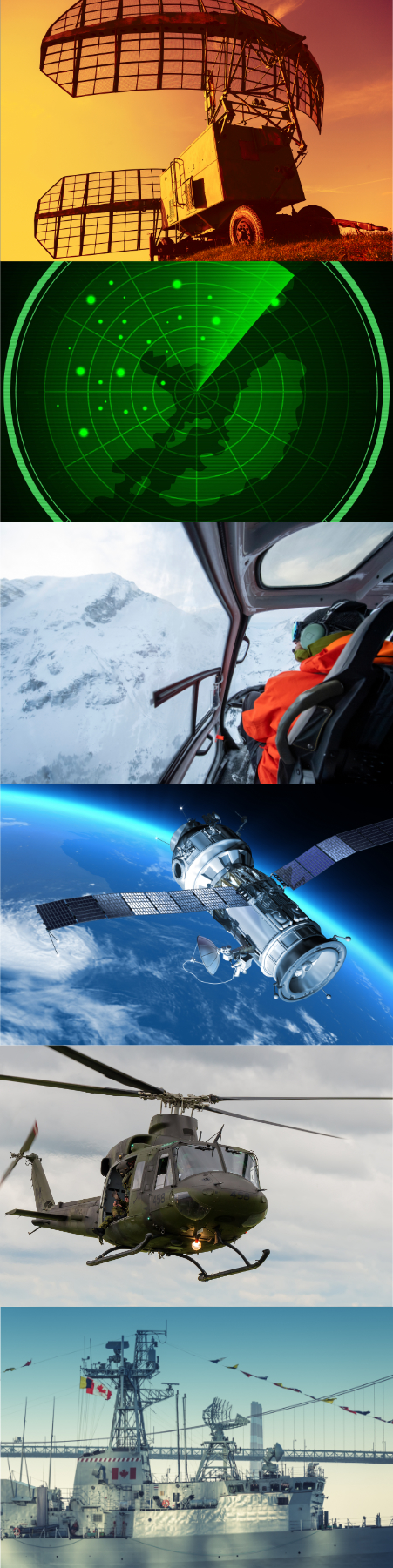
Defence
Technologies developed for defence applications have historically catalyzed powerful industrial advantage and broad societal benefit. From implantable health devices like pacemakers to agricultural drones to secure chips essential for self-driving cars, the cascade of positive impact on daily life is massive.
Modern defence platforms rely heavily on semiconductors, including and enabling technologies such as artificial intelligence (AI), machine learning, cloud computing and quantum. Ensuring a high-quality semiconductor supply and a robust domestic semiconductor design and development ecosystem is vital to Canada’s sovereignty and ability to meet our multinational defence commitments, including NATO and NORAD.
Dual-use technologies include innovations, materials, or systems that have been developed in either military or civilian domains but can be used in both. The extreme demands of military and security applications, including ruggedness and reliability, make them ideal for commercial and societal applications. Semiconductors developed for military aircraft are often integrated into commercial aircraft, satellites or even automotive vehicles because they greatly enhance safety and durability.
Semiconductor technologies developed for defence applications that have dual uses permeate a whole host of commercial industries:
- Mining: Secure, radiation-hardened processors designed to support military autonomy with real-time sensor fusion for hazard detection can be repurposed for predictive maintenance at mine sites.
- Agriculture: Low-cost agricultural drones can be modified for military use in conflict zones, while autonomous navigation and AI developed for military drones enable beyond-visual-line-of-sight operations for commercial tasks, reducing human risk. IoT and precision sensor networks originally created for farm management are leveraged in battlefield logistics and situational awareness systems.
- Aerospace: Radar and phased array systems developed for fighter jets can find their way into commercial aircraft. Radiation-hardened semiconductor technology is useful for both military applications on the ground and for space missions.
- Telecommunications: mmWave RF and beamforming technology that originated from defence research enable high-bandwidth, directional and adaptive communication systems, including 5G/6G. Advanced analog-to-digital converters and digital signal processors from defence applications improve signal quality and bandwidth handling in commercial telecom applications.
- Automotive: Semiconductor technology initially developed for defence is increasingly finding dual use in the automotive industry as it demands more secure, durable, and safety-certified chips for electric and autonomous vehicles.
- Marine: Uncrewed underwater vehicles (UUVs) and underwater robotics designed for security purposes can be used for pipeline inspection, maintenance and disaster response in the oil and gas industry, while sensors and unmanned systems for research on marine biodiversity, pollution and ecosystem management can be used for defence missions at sea.
- Medical: Military-grade chips designed for radar and secure communications led to more affordable and portable medical imaging devices, such as ultrasound systems. Chips designed for battlefield durability and energy efficiency are now used in implantable devices like pacemakers, insulin pumps and wearable health monitors. Secure processors and sensors originally developed for reliable, tamper-proof military equipment can be repurposed for commercial applications where high integrity, safety and regulatory assurance matter, including energy, automotive, healthcare, financial and critical infrastructure.
- Manufacturing: Radiation-hardened chips and advanced packaging designed for defence applications in extreme environments have moved into manufacturing, industrial automation and robotics. System-on-Chip (SoC) architectures and field-programmable gate arrays (FPGAs) with enhanced durability and thermal management are used for smart sensors, robotics and production line automation in modern manufacturing environments due to their security and extended lifecycle support.
- Energy: Betavoltaic battery cells using photovoltaic semiconductors for autonomous military sensors could potentially power wireless industrial sensor networks that have decades-long lifespans.
- Emergency Services / Preparedness: Both domains demand communications, computing, and decision-support infrastructure that stays secure, resilient, and interoperable across agencies and jurisdictions, including in degraded or hostile environments. Emergency services and defence systems both handle sensitive personal, operational, or classified information that must be protected with strong encryption, access control, and continuous monitoring.
MEMS enable reliable military precision
Micro-Electro-Mechanical Systems (MEMs) integrate mechanical elements, sensors, actuators and electronics on silicon chips to enable compact, rugged sensing and control in harsh environments, which is beneficial for defence systems.
MEMS enhance precision and reliability in military operations as a key part of low-cost, high-performance components for navigation, timing and communication systems. Their small size, low weight, and power efficiency are ideal for portable military gear and reducing deployment payloads.
MEMS also handle shock, vibration and extreme temperatures to support applications such as inertial sensors for precision-guided munitions, drones and personal navigation in jammed environments. They are also well-suited for timing oscillators for secure communications, signal processing and software-defined radios.
Materials make the difference in defence
Compound semiconductors underpin many of today’s most advanced defence systems by enabling higher power, higher frequency and more efficient and more compact RF, power and photonic devices than silicon can deliver.
A variety of compound semiconductors combining different materials are central to modern radar, electronic warfare, secure communications, infrared sensing and power conversion in platforms from missiles and radars to satellites and directed energy weapons.

Defence leverages light-based semiconductor technologies
Photonics technologies play a critical role in modern defense by enabling high-precision sensing, secure communications and directed-energy systems that enhance military effectiveness.
Through infrared cameras, LIDAR and hyperspectral imaging, Photonics supports intelligence, surveillance and reconnaissance. Fiber optics ensure high-speed, secure data transfer immune to electromagnetic interference — characteristics that are vital for submarines, drones and command systems.
Photonics-based systems are often faster, more efficient and durable than electronic alternatives and underpins global information grids, GPS stability and multi-die systems for aerospace applications.
Photonics technologies developed for defence applications frequently find their way into civilian and commercial settings. Healthcare, infrastructure and transportation are replete with examples. The principles behind military night vision applications inform advanced endoscopy and low-light medical cameras for minimally invasive procedures. Fiber optics from military networks power high-speed internet and 5G infrastructure.
Photonics also enables quantum technologies. Quantum computing uses photons as qubits by leveraging the properties of light for low-noise operations and networking. Photonics also helps to encode quantum information; quantum encryption and advanced sensing both have defence and civilian applications.
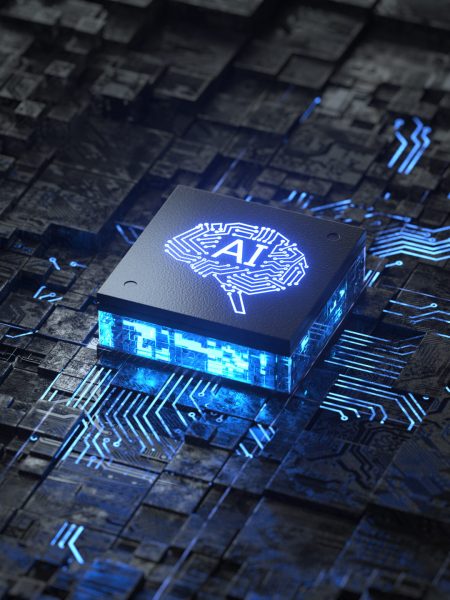
Semiconductors make defence systems smarter
Semiconductor technology makes AI systems for defence possible.
Semiconductors provide the foundational hardware in systems that train large models in data centers and run compact, rugged AI inference engines in missiles, drones, command systems. They also power platforms for intelligence, surveillance and reconnaissance.
Semiconductors are essential for the compute, memory, sensing, power, and secure-communication functions needed to turn algorithms into deployable, resilient battlefield capabilities.
Defence systems integrate memory, radio frequency and sensor semiconductors into tightly coupled modules. This enables AI to ingest multi-sensor data, fuse it, and act within the milliseconds necessary to respond to hostile threats on the ground, in the air and underwater.

Defence makes a quantum leap
Quantum technologies in defence and security span sensing, communications, computing and simulation.
- Gravimeters, magnetometers and inertial sensors that are quantum-based can detect minute variations in gravity or magnetic fields for submarine tracking, underground structure detection and GPS-independent navigation. independent navigation.
- Quantum key distribution and entanglement-based communications links enable secure channels for strategic networks, satellites and critical infrastructure.
- “Physics-level” simulations accelerated by quantum computing enable detailed modelling and analysis of materials, weapons and sensors, supporting tasks such as the evaluation of new materials, the performance testing of weapon systems, and the optimization of sensor technologies.
- These simulations support “decision-level” applications for operations planning, logistics management and training scenarios.
Applications developed for defence that have commercial applications include quantum sensing, quantum cryptography, optimization and simulation.
Quantum sensors are already deployed in niche but real applications such as ultra-precise navigation without GPS, magnetic surveying for mining and geoscience, underground/undersea infrastructure inspection, and medical sciences.
Because quantum computing poses a threat to traditional cybersecurity, quantum cryptography is being developed to secure sensitive data across industries, including finance, healthcare and defence.
Quantum algorithms developed in the defence sector can be applied to solve optimization problems in commercial industries to benefit supply chain logistics, production scheduling, financial portfolio management and materials sciences.

A dual opportunity for global success
The intersection of defence and civilian technologies, particularly in the realm of semiconductors and quantum innovation, continues to drive transformative progress across a wide range of industries. By fostering a robust ecosystem for dual-use applications, Canada can enhance its sovereignty, strengthen multinational commitments and fuel economic growth while improving the quality of life for its citizens.
The examples outlined above — from healthcare and emergency services to manufacturing, energy, and telecommunications — demonstrate that investments made in military research often yield significant civilian benefits. These innovations not only increase safety and resilience but also spur technological leadership and competitiveness in Canada and globally.