
Mining
Silicon in the Soil: Driving Canada’s Modern Mine.
Mining
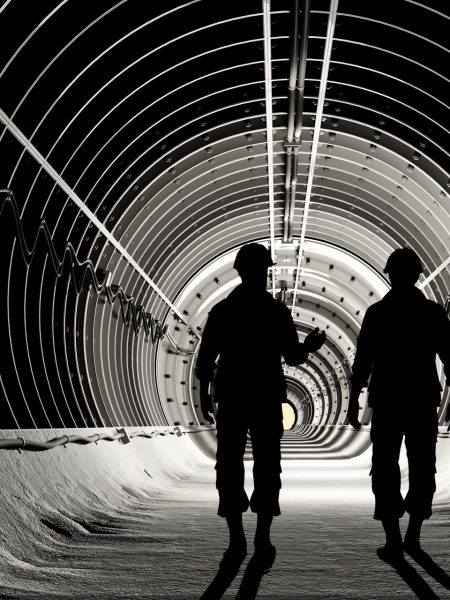
The success, safety and sustainability of Canada’s mining sector are made possible by semiconductors – the mining and semiconductor industries have a deep and symbiotic connection.
The mining industry benefits from semiconductor technology in the field, whether it’s for exploration or active mining operations.
Advanced sensors, robotics and autonomous mining systems are replete with semiconductor technology. They power the intelligence that underlies equipment automation, high-performance communication, predictive maintenance and environmental monitoring. Mining operations integrate semiconductor-based devices for real-time equipment health tracking, ore sorting, autonomous drilling and safety management.
Outside of the mine, AI-driven digital twins and data analytics depend on microchips with high processing capacity. They improve mining output, reduce costs, ensure regulatory compliance and foster sustainability.
Semiconductor Sensors Make Mines Safe
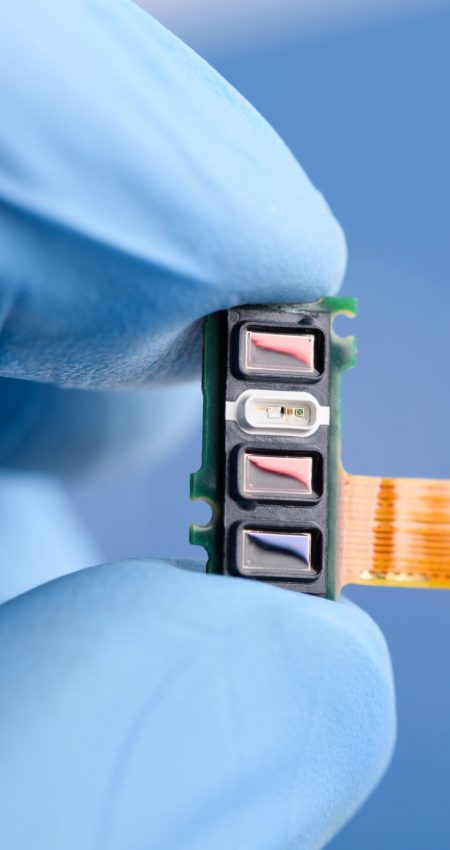
Mines employ a whole host of connected sensors that ensure the integrity of minds and the safety of workers. Sensors are fundamental for smarter, safer mines.
Sensors continuously monitor mines for potential hazards. When detected, they deliver instant alerts to ensure faster interventions, minimize human error and mitigate the risk of accidents and injuries.
Smart sensors ensure both the health of workers and of mining equipment. They support predictive maintenance to reduce operational downtime and disruptions that could impact the profitability of the mine and the entire mining enterprise.
Many types of sensors deployed in mining operations are made possible by advances in semiconductor technology:
- Vibration and seismic sensors: Surface Mount Technology (SMT) accelerometers and seismic sensors detect mechanical instability, ground upheaval, and early signs of rock falls or collapses.
- Airflow and pressure sensors: Mine shaft ventilation and hydraulic systems can be monitored to maintain safe working conditions and prevent equipment failure. Airflow monitoring reduces risks of gas build-up or suffocation events.
- Gas and smoke detectors: Semiconductor sensors can detect hazardous gases such as carbon monoxide, methane and smoldering fires, triggering alerts for evacuation or intervention to reduce the risk of poisoning or explosion.
- Temperature and humidity sensors: Specialized sensors monitor underground temperature and humidity to identify risks for heat-related illness among workers as well prevent equipment from overheating.
- Wearable safety devices: Semiconductor-based, hands-free wearables track worker location, vital signs and environmental exposure, alerting operators to equipment malfunctions, gas leaks, or entry into hazardous zones.
- Imaging and mapping sensors: Millimeter wave radar, advanced visual sensors, and mapping chips generate real-time 3D models of mine environments. This helps detect cracks, faults and obstructions – especially useful in low-visibility conditions where traditional cameras and LiDAR are insufficient.

MEMS: Ideal for Mine Monitoring
Semiconductors based Micro-Electromechanical Systems (MEMS), technology devices that combine tiny mechanical and electronic components on a microscopic scale and built on semiconductor technology, are particularly useful. MEMS-based devices are widely deployed in industrial condition-based monitoring systems for predictive maintenance.
MEMS-based accelerometers measure vibrations along multiple axes, allowing high-resolution detection of changes in frequency, amplitude or vibration signatures that precede hardware failure, such as bearing degradation, gear misalignment, or shaft imbalance. These accelerators are small and cost-effective, offering integrated digital output and stable sensitivity over temperature.
Vibration data is continuously collected and sent to monitoring systems, where algorithms compare live sensor readings against healthy baselines. Early warning signs include vibration increases at specific harmonics, spikes in amplitude or irregular frequency events that indicate emerging faults.
When anomalies are detected by the MEMS accelerometer data, automated alerts are triggered for manual inspection or predictive maintenance, allowing timely intervention before full failure.

Semiconductor Technology for Mining Prioritizes Reliability
Semiconductor reliability standards for mining go far beyond generic standards for most industries. They must be able to tolerate frequent mechanical shocks, heavy vibration, electromagnetic interference, wide temperature swings, humidity and corrosive atmospheres.
Reliability tests and models for semiconductor technology in mining are tailored to actual mine operating conditions. This includes temperature cycles, shock profiles, voltage/load patterns and environmental exposure.
Semiconductor-based technology in mining environments is application specific. It requires extensive testing, environmental hardening and dynamic monitoring to maintain safe, uninterrupted operations. Not only does semiconductor technology for mining need to last for many years, it must endure in harsh, unpredictable conditions in locations where replacement and repairs are cost-prohibitive and hazardous.

Autonomous Vehicles Keep Mines Moving
Autonomous vehicles are revolutionizing the mining industry — and semiconductors power the intelligence that drives them. Autonomous mining trucks improve efficiency, safety and sustainability.
Advanced AI-driven fleet management, sensors, LIDAR, and real-time data analytics allow autonomous mining vehicles to operate 24/7. This reduces human exposure to hazardous conditions and overwork. Supported by precision navigation systems and robust 5G networking for real-time coordination and remote operation, these vehicles reduce environmental impact through smarter, continuous mining operations managed remotely by AI and advanced sensors. Electrified and hybrid drivetrains similarly contribute to reduced emissions.

AI, High Performance Computing, AI and Quantum Computing
AI and high-performance computing are deployed extensively throughout the mining value chain to optimize efficiency, enhance productivity, ensure safety and foster sustainability.
- Machine learning algorithms can forecast mineral demand, reducing waste and unnecessary drilling by analyzing geological data for precision targeting of mineral deposits.
- Computer vision can automate ore sorting and grading, significantly speeding up the classification process and improving accuracy compared to manual methods.
- Energy and water consumption in mining facilities can be optimized, substantially saving resources and reducing environmental impact.
- Predictive maintenance systems minimize downtime by analyzing sensor data to foresee machinery failures.
Quantum computing in mining is evolving from theoretical to practical to help address critical industry challenges to support innovation in mineral discovery, extraction, and resource management.
Quantum computing is also being explored for different aspects of mining, including mineral exploration and equipment optimization, as it exceeds the capabilities of classical computing. Quantum computers can process vast datasets from satellite and ground sensors. That supports the development of highly precise geological models that can more accurately detect ore deposits— reducing unnecessary drilling and improving exploration yields.
The combination of quantum sensors with AI and classical methods accelerates exploration timelines and lowers environmental impact through less invasive surveying. Advanced quantum sensors provide high-resolution, low-drift subsurface imaging for mineral prospecting and resource estimation.
Mining operations can be optimized by quantum algorithms, which can solve highly complex optimization challenges, such as equipment configuration, scheduling and predictive maintenance. They even support real-time process adjustments for resource flow and waste reduction across mining operations.
Quantum computing is expected to expand into novel material science. It has the potential to help design new catalysts for more efficient extraction, corrosion-resistant alloys for equipment, and innovative green technologies that will become essential as low-carbon mining scales up.
With supply chain disruptions and geopolitical uncertainty upsetting global trade relationships, stronger collaboration between the domestic semiconductor sector and mining operations will enable both to capitalize on emerging opportunities.