

The quantum mechanical properties of light can be exploited in various ways to enhance the performance of sensors, communication channels, computers, etc. Some of these information-processing enhancements are quantitative (e.g., improving signal-to-noise ratios), while others are revolutionary (e.g., fault-tolerant quantum computing, ‘perfectly secure’ communication). Building quantum information processing systems using integrated silicon photonics provides the advantage of a scalable platform based on silicon manufacturing.
The NSERC CREATE NUCLEUS and Quantum BC programs and CMC Microsystems along with FABrIC—a project funded by the Government of Canada and managed by CMC Microsystems—bring to you a workshop on the design, fabrication, and testing of quantum silicon photonic circuits used in quantum information processing hardware.
The workshop will teach participants how to design, simulate, fabricate, and test their own quantum silicon photonic circuits. Students will gain an understanding of the fundamentals of quantum optics and how photonics (particularly integrated photonic circuits) can be used for quantum information processing. During the workshop, students will practice creating a design and layout of a quantum silicon photonic circuit. Students will brainstorm and pitch their circuit ideas to researchers at leading universities and industries. After the workshop, students will have several months to complete their design and submit their circuits for ANT fabrication. Participants will test their chips using equipment at their own university or by their own arrangements.
What You Will Learn
The following topics, but not limited, will be covered in the workshop:
- High level overview of quantum optical applications (sensing, communication, computing)
- Introduction to silicon quantum photonics, quantum optics theory, and non-linear optics
- Example circuits
- Survey of components (waveguides using Si and SiN, single photon and photon pair sources, single photon detectors, interferometers, etc.)
- Integrated photonic circuit design tools and methods
- Fabrication processes
- Physical implementation of quantum photonic devices
- Process design kit and layout-centric photonics design flow
- Test methods, equipment, facilities, design for test rules
Important Notes:
- The representing organizations of the interested participants who register the ANT fab option may be required to sign a 2-way Non-Disclosure Agreement (NDA) with CMC Microsystems. Please reach out to our Legal team at legal@cmc.ca to facilitate execution of the NDA before June 1, 2026.
- Workshop participants will have access to other proprietary and confidential information during the course; each participant is required to agree to the terms of the Access to Intellectual Property & Non-Disclosure Agreement at the time of registration.
- International participants who register for the ANT fab option will be required to complete an export control questionnaire for ANT chip fabrication. Contact Sarah Neville to get a copy of the questionnaires.
Schedule
The following schedule is subject to change.
The following schedule (click to enlarge) is subject to change.
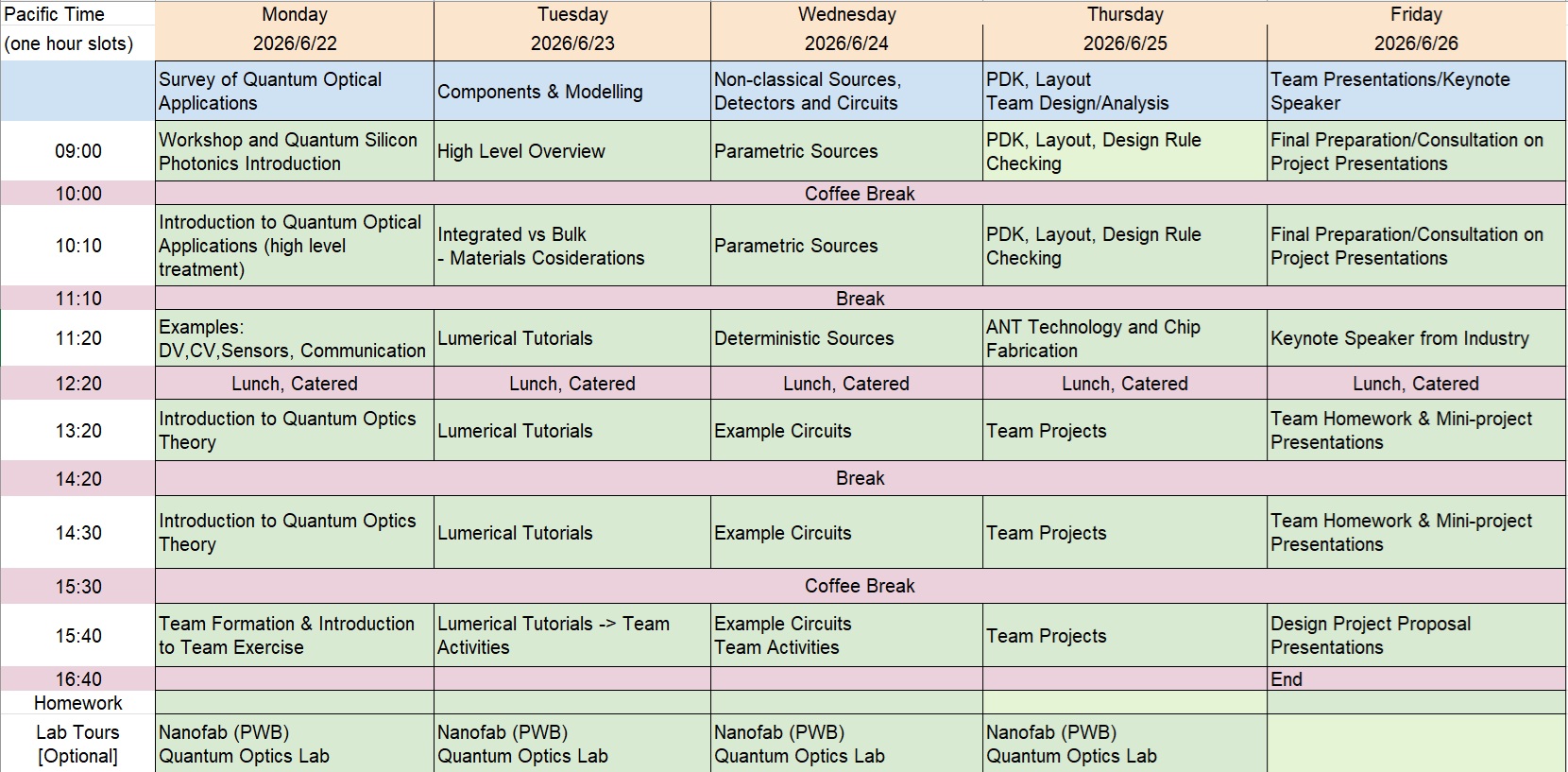
| Pacific Time | Monday 2026/6/22 | Tuesday 2026/6/23 | Wednesday 2026/6/24 | Thursday 2026/6/25 | Friday 2026/6/26 |
|---|---|---|---|---|---|
| Survey of Quantum Optical Applications | Components & Modelling | Non-classical Sources, Detectors and Circuits | PDK, Layout Team Design/Analysis | Team Presentations / Keynote Speaker | |
| 09:00 | Workshop and Quantum Silicon Photonics Introduction | High-Level Overview | Parametric Sources | PDK, Layout, Design Rule Checking | Final Preparation / Consultation on Project Presentations |
| 10:00 | Coffee Break | ||||
| 10:10 | Introduction to Quantum Optical Applications (high-level treatment) | Integrated vs Bulk – Materials Considerations | Parametric Sources | PDK, Layout, Design Rule Checking | Final Preparation / Consultation on Project Presentations |
| 11:10 | Break | ||||
| 11:20 | Examples: DV, CV, Sensors, Communication | Lumerical Tutorials | Deterministic Sources | ANT Technology and Chip Fabrication | Keynote Speaker from Industry |
| 12:20 | Catered Lunch | ||||
| 13:20 | Introduction to Quantum Optics Theory | Lumerical Tutorials | Example Circuits | Team Projects | Team Homework & Mini-project Presentations |
| 14:20 | Break | ||||
| 14:30 | Introduction to Quantum Optics Theory | Lumerical Tutorials | Example Circuits | Team Projects | Team Homework & Mini-project Presentations |
| 15:30 | Coffee Break | ||||
| 15:40 | Team Formation & Introduction to Team Exercise | Lumerical Tutorials → Team Activities | Example Circuits + Team Activities | Team Projects | Design Project Proposal Presentations |
| 16:40 | — | — | — | — | End |
| Homework | — | — | — | — | — |
| Lab Tours (Optional) | Nanofab (PWB), Quantum Optics Lab | Nanofab (PWB), Quantum Optics Lab | Nanofab (PWB), Quantum Optics Lab | Nanofab (PWB), Quantum Optics Lab | — |
Access to Tool
- Lumerical offers workshop attendees in Canada free access to the Lumerical workshop license during the workshop and following the workshop for the purpose of completing their designs.
- International and industry participants may require their own license to this tool. Contact CMC to check/confirm.
Equipment Requirements
Attendees should bring their laptops to participate in all hands-on activities. However, it is recommended to use a Windows or a Mac with a Windows Virtual Machine.
Confirmed Instructors
| Name | Affiliation | Webpage |
|---|---|---|
| Jeff Young | University of British Columbia | Jeff Young |
| Amr Helmy | University of Toronto | Amr Helmy |
| Lukas Chrostowski | University of British Columbia | Lukas Chrostowski |
| Andreas Pfenning | Julius-Maximilians-Universität Würzburg | Andreas Pfenning |
| Kero Lau | Simon Fraser University | Kero Lau |
| Piotr Roztocki | Ki3 Photonics Technologies Inc. | Piotr Roztocki |
| Cameron Horvath | Applied Nanotools Inc. | Cameron Horvath |
| Benjamin Crockett | University of British Columbia | Benjamin Crockett |
Travel and Accommodations
Participants make their own travel and accommodation arrangements. Recommendations include Affordable Hostels in Vancouver – UBC Accommodation, Visitor Housing, Carey House, TRIUMF House, UBC Suites, St. John’s College, Green College, and Airbnb.