
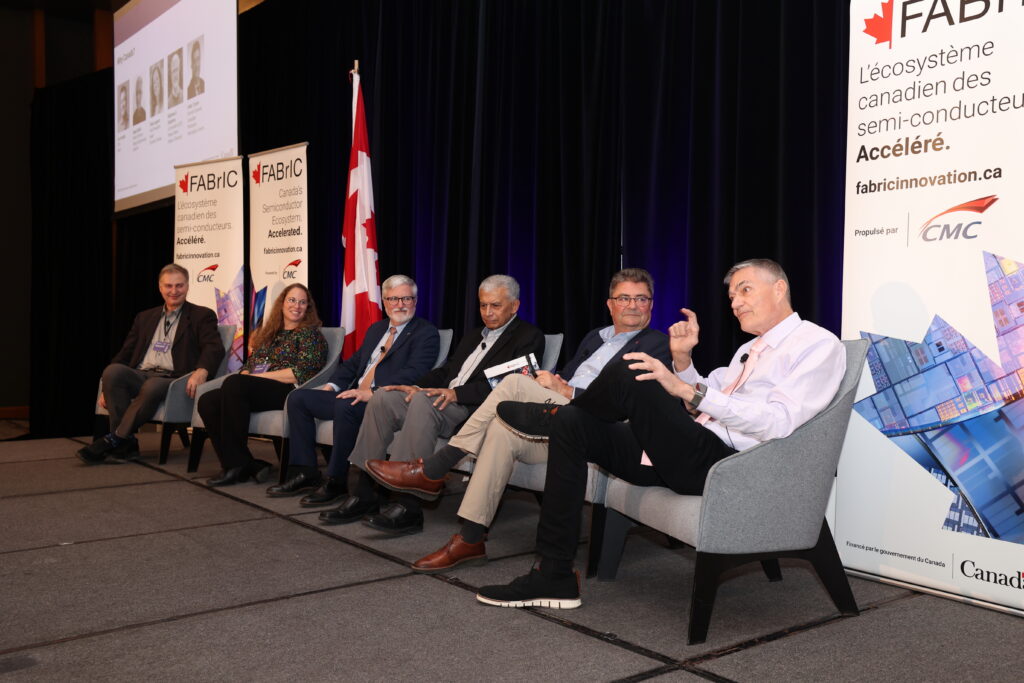
By Gordon Harling, President and CEO of CMC Microsystems
The overriding theme at Where Sovereignty Meets Prosperity: Canada’s Semiconductor Symposium is that industry has a clear opportunity to leverage our strengths in the semiconductor supply chain and drive sovereignty and prosperity for the country.
Realizing this opportunity means staking a claim in the technology stack by building companies that stay in Canada while collaborating with global partners. We do not need to manufacture everything ourselves, but we need to build capabilities that customers want, retain more of the value we create, and give the world compelling reasons to work with Canadian companies.
With its rich telecommunications history that has positioned us well to capture opportunities in compound semiconductors and photonics, Kanata was an appropriate host for CSS. As its federal MP Jenna Sudds emphasized, the national capital region’s researchers, engineers, technicians, and entrepreneurs contribute far beyond its boundaries. Supporting their growth means helping companies move from research to products, growing customers, and manufacturing here in Canada.
Kanata’s history was brought into focus by Terry Matthews, founder and chairman of Wesley Clover International, who recounted the early days of Mitel. New semiconductor technology allowed a Canadian startup to solve customers’ problems with smaller, more economical hardware. International relationships helped turn that advantage into a global business.
That’s not to say we should create the past, but it’s a reminder that customer needs, technical differentiation, and partnerships remain the foundations of commercial success.
Build around capabilities that matter
Matthews sees another substantial opportunity in enterprise AI at the network edge and in connected sensors. Companies want intelligence close to their operations and greater control over their data. Canada has relevant capabilities, but capturing the opportunity requires ambition and engagement with customers. He said we shouldn’t wait for someone else to define our role.
Ewit Roos, founder of PhotonDelta, reinforced the need for focus, drawing on the Netherlands’ experience. Countries cannot lead everywhere, he noted, but they can identify where their capabilities can make a difference in global markets and build an ecosystem around them. That requires alignment across industry, research, and government, along with sustained commitment.
The Canadian Photonics Fabrication Centre (CPFC) is a compelling example of the strengths we can build upon. The federal government’s announced plan to spin CPFC out of the National Research Council into a commercial entity is intended to attract private capital and expand domestic photonic semiconductor manufacturing. It offers a path to scale an established national capability as demand grows across communications, AI, sensing, and quantum technologies.
Velko Tzolov, CPFC Director General, emphasized that a fabrication facility matters beyond the devices it produces. They anchor relationships among customers, suppliers, and educational institutions. Close engineering collaboration, geographic proximity, and a workforce drawn from universities and colleges help make those relationships durable. Facilities such as the CPFC become centres of gravity for industrial development.
Joe Costello, CEO of Inpho, echoed Tzolov’s views — he sees CPFC, Canada’s photonics expertise and its high-speed electronics talent as reasons to build Inpho here. He said establishing backend manufacturing in Halifax illustrates how different regions can contribute complementary capabilities, and that Canada does not have to concentrate every activity in one location to build a competitive national industry.
CMC plays a key role in connecting these capabilities, supporting researchers and companies across microelectronics, photonics, MEMS, and superconducting technologies while linking Canadian innovators to international networks. Those connections provide access to expertise, infrastructure, and market opportunities far beyond the domestic market.
Turn projects into lasting industrial capability
Supporting a company’s product development can also strengthen manufacturing processes, integration expertise, and reusable platforms. The objective is not simply to fund individual successes, but to expand what Canadian industry can design and manufacture.
FABrIC, a Government of Canada Strategic Response Fund initiative managed by CMC Microsystems, is focused on building a vibrant and sustainable Canadian semiconductor ecosystem anchored by world-class talent and global impact. It builds on that approach.
The symposium’s IoT showcase featured five FABrIC recipients addressing distinct parts of that opportunity:
- Sheba Microsystems: MEMS actuators for temperature compensation in advanced driver-assistance cameras.
- Micro-°K: advanced MEMS thermal-sensor fabrication.
- Blumind: ultra-low-power analogue AI for IoT and wearables.
- SPARK Microsystems: a low-energy, low-latency wireless system-in-package for AI wearables.
- Ranovus: accelerated development of an ODIN optical-engine prototype through its Raptor project.
The fabrication projects showcased five organizations developing complementary process capabilities:
- Luqia Technologies: alongside the awarded INO project establishing Canadian thin-film lithium-niobate integrated-circuit prototyping and fabrication capacity.
- AEPONYX: developing integrated photonic platforms, including technology for quantum applications.
- Jones Microwave: scaling high-frequency, high-power, high-speed light-activated solid-state plasma switches.
- TransEON: commercializing domestic gallium-nitride MOS RF foundry processes.
- Norcada: developing fabrication processes for next-generation semiconductor hybrid biosensing.
These projects illustrate how company growth and industrial capability reinforce each other. Micro-°K’s work with C2MI advances materials, release processes and wafer bonding, while its remaining overseas packaging requirement identifies a Canadian capability gap. SPARK’s project develops connectivity technology with applications beyond a single wearable product. Ranovus’ experience demonstrates how timely support can help a company respond to a demanding customer opportunity.
The capabilities and skills developed through FABrIC support have a long life after these projects are completed.
But technical capability alone does not ensure that Canada captures the returns. Douglas Morrison, President and CEO of the Centre for Excellence in Mining Innovation (CEMI), emphasized the need to protect intellectual property, commercialize innovations and reach international markets. His concerns about delays in Canadian patent processing underscored the importance of treating IP as an economic asset, not an administrative afterthought.
IP is tied to resilience. Hamid Arabzadeh, chairman and CEO of Ranovus, said building globally competitive Canadian-owned companies requires experienced investors, trusted customer and supplier relationships, and capital that supports scale. International engagement and staying Canadian are compatible ambitions, provided we create conditions that allow Canadian companies to retain and commercialize their IP.
Skills must be part of the scaling strategy
Just as important as equipment, processes, and IP is expertise. Yassine Hariri, who manages CMC’ssemiconductor upskilling program, framed the skills discussion around the full journey from an idea to a useful product: design, simulation, verification, packaging, integration, validation and manufacturing. Missing expertise at any stage can become a bottleneck for the entire business.
FABrIC’s upskilling efforts address that practical challenge. Graduates need help translating their education into productive engineering work, while employers need ways to close skills gaps throughout their teams. Training should not stop after someone’s first job or be treated as something only junior employees require. The symposium’s skills discussion highlighted the substantial time and senior-engineering effort involved in making new hires independently productive.
Arabzadeh emphasized familiarity with engineering tools, technical judgement, and early involvement with companies. Those priorities point toward training connected to real product development requirements. Helping graduates contribute sooner and experienced employees update their capabilities strengthens the return on every other industrial investment.
Scale dual-use technologies through civilian needs
The dual-use panel connected these capabilities with healthcare, aerospace and security. Civilian competitiveness and defence readiness draw on the same innovation ecosystem, noted panel moderator Maura Campbell, President and CEO of OBIO. Technologies developed for challenging environments can serve multiple markets, helping companies grow while strengthening national capability.
Qidni Labs illustrated the value of that approach. Morteza Ahmadi, founder and CEO, described how discussions with defence users revealed requirements beyond those of a controlled dialysis clinic, including transport and temperature exposure. Those conversations also identified potential applications in treating critically injured patients by correcting blood chemistry. Working with end users can improve a product while uncovering needs its developers had not anticipated.
CMC’s proposed Dual-Use and Emergency Technologies program, DUET, would put civilian emergencies at the centre of this commercial strategy. Fires, floods, storms, search and rescue, and first-response operations create urgent needs for reliable technology. Serving those markets can help companies establish revenue and demonstrate performance rather than depend exclusively on a prospective government defence sale.
DUET would support development through to field trials, helping companies deliver mature, manufacturable products rather than stopping at prototypes. It remains a proposal, extending lessons from FABrIC into a lab-to-field pathway that connects commercial growth with emergency preparedness and defence requirements.
Build Canadian companies for global opportunities
Costello sees the ingredients for enduring Canadian businesses whose success can generate further ventures, investment and expertise, while Matthews sees substantial opportunity in edge AI and connected devices. Both depend on turning Canadian talent and technical capability into a repeatable process of building companies.
Canada’s sovereignty will grow through capabilities we control and partnerships we earn as we make contributions in optical connectivity, advanced sensing, edge computing and the systems they enable. The opportunity is global. Our task is to build Canadian companies capable of taking it.